Lone Star Drone
Jul 9, 2025
What Drone Pilots Need to Know in 2025
1 | No Ban Yet—But the Warning Lights Are Flashing
During almost every sales call, training day, and lunch-and-learn this year we’ve heard the same anxious refrain from surveyors, public-safety chiefs, and construction superintendents across Texas:
“What happens if Washington pulls the plug on DJI?”
A blanket prohibition has not happened, but four converging pressure points are already disrupting daily operations and supply chains:
Customs bottlenecks. Since late 2024, U.S. Customs & Border Protection has been detaining inbound DJI airframes under the Uyghur Forced Labor Prevention Act (UFLPA). Entire container loads now sit in secondary inspection for three to six weeks, leaving shelves at Best Buy, B&H, and Amazon completely bare.
FCC slow-walk. Separate from CBP, the Federal Communications Commission has paused equipment authorizations for several unreleased DJI radios while lawmakers debate the Countering CCP Drones Act. Without an FCC grant, a new drone or controller cannot be legally marketed in the United States, effectively freezing the product pipeline.
NDAA ticking clock. Section 1709 of the FY-2025 National Defense Authorization Act orders a federal security review of DJI technology by 23 December 2025. If no agency completes that audit, DJI could be added to the FCC “Covered List” automatically—triggering import bans for new gear and potentially invalidating authorizations for existing radios.
Draft executive actions. White-paper language circulating on Capitol Hill and in the Commerce Department proposes extending any eventual DJI restrictions to federally funded infrastructure projects and critical-infrastructure airspace, a move that would ripple into state-level contracts almost overnight.
Bottom line: There’s no nationwide ban today, but parts shortages, delayed deliveries, and a cloud of regulatory uncertainty are already forcing Texas operators to rethink fleet planning and client commitments.
2 | Who Feels the Pinch First?
Survey & mapping firms. Teams that rely on M30 or Mavic 3 E units for centimeter-grade photogrammetry have discovered that ordering even a single replacement battery now requires back-ordering through three different distributors.
Public-safety agencies. Fire departments and sheriff’s offices running Matrice 300/350 platforms for overwatch and crash reconstruction report wait times of 8-10 weeks for gimbals or motor arm replacements, grounding critical missions.
Construction progress managers. GCs who turned to Mavic 3 Multispectral or Avata FPV for weekly site capture are juggling loaner units or paying subcontractors when their own drones sit in a repair queue.
If federal restrictions tighten, parts scarcity and warranty service delays will escalate further, just when hurricane-season, roof inspections, wildfire mapping, and Q4 site audits peak in Texas.
3 | Why Teledyne FLIR SIRAS Is the Domestic Platform to Watch
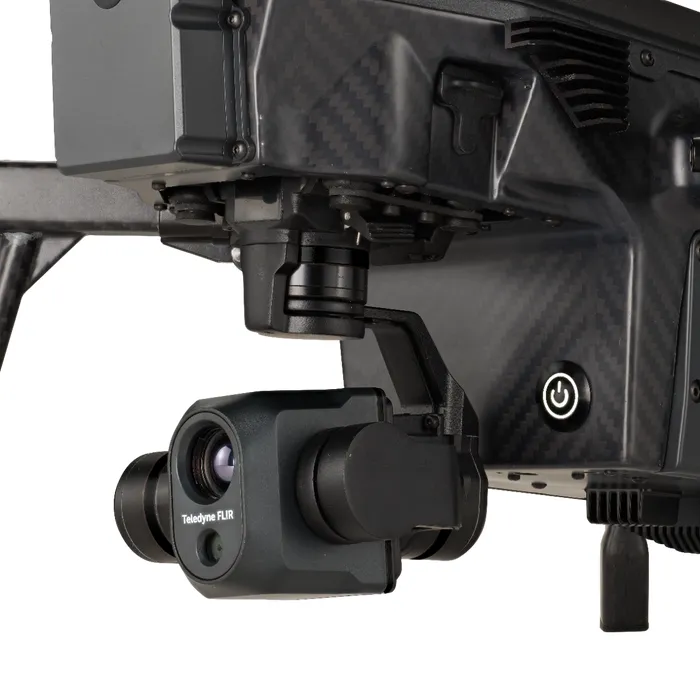
Rather than hunting for scarce DJI stock or piecing together a mixed fleet, many operators are test-driving Teledyne FLIR’s SIRAS quad-copter. Assembled and supported in the USA SIRAS offers two critical advantages: a stable, mostly U.S. controlled supply chain and FLIR-grade thermal intelligence.
Supply you can actually receive. Units ship straight from USA with lead-times measured in days, not weeks or months.
Dual-sensor payload. The Vue TV128 pairs a 640 × 512 radiometric core with a 16 MP visible camera, delivering temperature data that slot cleanly into FLIR Thermal Studio.
Hot-swappable batteries. Keeps pit-stops under one minute and maintains aircraft power during critical battery swaps. This is crucial for large solar-field inspections and extended fire/public safety overwatch.
Zero geofence lockouts. No automatic “no-fly” zones means the pilot retains full Part 107 responsibility during flight.
Blue-sUAS trajectory. Teledyne is working on DoD vetting; once blue-listed, SIRAS will qualify for federal grant dollars that currently exclude many Chinese-origin drones.
We’ve flown SIRAS over roofing hot-spots, solar farms, and search and rescue training.


4 │ Countdown Calendar—Four Realistic Policy Scenarios and When They Could Hit
To help clients plan, Lone Star Drone tracks four plausible regulatory milestones and the earliest dates they could bite:
Date | Scenario | Practical impact |
Oct 2025 | FCC “Covered List” expansion gains Senate support | New DJI radios lose U.S. equipment authorization; no more M4P or M30T successor releases. |
Dec 2025 | NDAA security review deadline passes with a negative finding | Any federal-funded job (DOT, FEMA, USDA) must shift to a non-DJI platform or lose reimbursement. |
Q1 2026 | UFLPA Phase-2 enforcement widens to all lithium-ion cells | DJI batteries held at port; third-party cells flagged as “unk origin,” creating a battery drought. |
Mid-2026 | Executive order on critical-infrastructure airspace | Utilities and refineries must use Blue-sUAS or waiver-approved drones to fly within secure perimeters. |
5 | Action Items to Stay Ahead of the Curve
Audit & document your fleet. Record every serial number, firmware build, and remaining warranty term so you know which assets are at highest risk if authorizations change.
Stock the irreplaceables. Props, batteries, gimbal cables; anything you can’t buy locally in 48 hours, should be stocked up in your shop!
Test a second brand now. Book a demo with Lone Star Drone to put SIRAS or Autel sensors to the test and validate accuracy before you need a last-minute swap.
Re-read your insurance policy. Some liability riders name specific hardware; make sure “equivalent UAS” language keeps you covered if you pivot away from DJI mid-contract.
Watch the policy ticker. CBP directives, FCC rule-makings, and NDAA updates change monthly; we push real-time alerts to our clients so surprises never reach the field first.
Building a Resilient Parts Pipeline. We'll discuss this in the next section.
6 │ Building a Resilient Parts Pipeline: Lessons from the Ag, Oil & Gas Playbooks
Agricultural co-ops and petrochemical plants live or die by uptime, so they stock spares in three concentric circles. Apply the same idea to drones:
Red-tag bin (on-site, immediate use) Props, landing gear, gimbal dampers: items that turn a five-minute mishap into a same-day relaunch.
Yellow-tag locker (regional, two-day courier) Batteries, chargers, payload ribbon-cables: kept at a nearby branch office or partner integrator.
Green-tag depot (central, one-week freight) Airframes, controller screens, spare payloads: shared across multiple districts to smooth out capital cost.
We help clients populate each tier with either OEM or NDAA-compliant alternates so a single port delay never stalls a project.
7 | How Lone Star Drone Can Keep You Flying
Hands-on demo & rental pool. Try SIRAS before you commit capital, and rent short-term units (if available) if your DJI workhorse goes into extended repair service.
Turn-key capture crews. Should your own fleet be grounded by a sudden parts shortage or policy shift, our Part 107 pilots can mobilize statewide and nationwide, keeping project timelines intact.