
Lone Star Drone
Sep 17, 2025
Understanding drone flight, stability, communication, and the technology that keeps them in the air
How Do Drones Actually Work?
Drones have become an established part of modern operations across multiple industries. They are visible on construction sites, in agricultural fields, at public events, and within emergency response efforts. Although they are increasingly common, many people are not familiar with how drones actually function.
At Lone Star Drone, a veteran-owned company based in the Dallas–Fort Worth area, we specialize in professional drone services, commercial drone repair, and aerial media production. Our work covers a wide range of applications, including construction drone photography, architectural drone video, public safety drone support, and industrial inspection services. Because we also operate a full-service drone repair shop, we understand these aircraft from both the technical and operational perspectives.
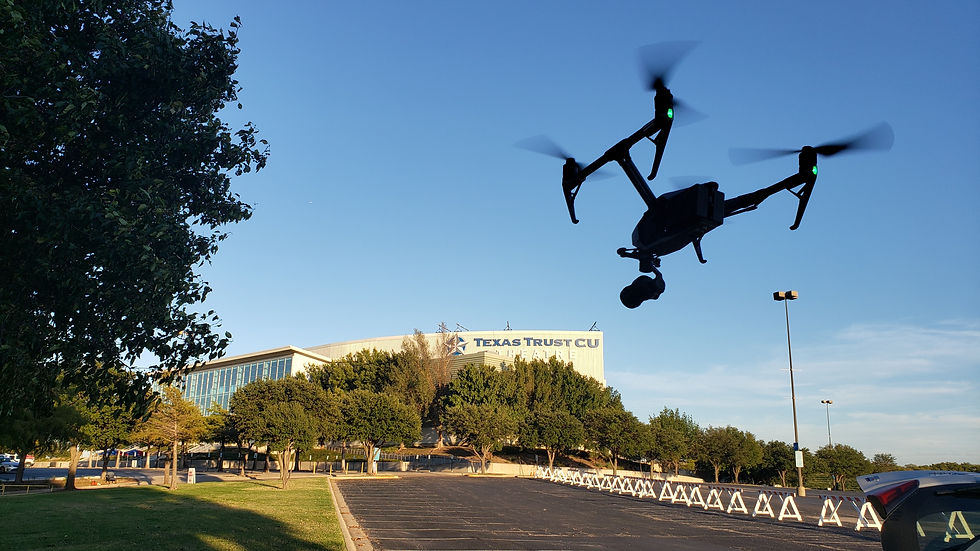
A drone is a coordinated system that combines motors, sensors, processors, and communication links. Each of these components serves a specific purpose. Propellers generate lift, the onboard sensors and processors maintain balance, GPS modules provide location accuracy, and communication links transmit information between the aircraft and the operator.
The reason drones have become so versatile is because these systems can be applied in many different contexts. The same hardware and software that allows a drone to hover steadily for a construction progress photo can also be used for a roof inspection, a crop survey, or cinematic drone videography for marketing campaigns. This adaptability is what makes professional drone services valuable for businesses, municipalities, and individual clients.
This article will examine how drones work in practical terms. It will cover what drones are useful for, how they achieve controlled flight, how they maintain stability, and how they communicate with the controller. It will also address additional systems that support safe and reliable operation. The goal is to provide a clear, factual overview of how drones function and why they are increasingly relied upon in drone media projects, enterprise drone solutions, and drone repair services.
Before We Move On: What ARE Drones Are Helpful For?
Modern drones are far more than recreational gadgets. They have become critical tools in professional environments where efficiency, accuracy, and safety are essential. At Lone Star Drone, we see every day how commercial drone services provide measurable value to businesses, municipalities, and organizations across Texas and nationwide.
Construction and Architecture: Drones are now standard on job sites for construction progress photography, drone mapping, and 3D modeling. Aerial images allow project managers and architects to monitor timelines, track materials, and document milestones without the cost of manned aircraft. Drones also support roof inspections and structural surveys, helping teams identify potential issues before they become costly problems.
Public Safety: Law enforcement agencies, fire departments, and emergency management teams rely on public safety drone operations to gain real-time situational awareness. Drones can search large areas quickly, monitor crowd activity, and provide live aerial video during critical incidents. Thermal imaging and night-vision equipped drones further extend these capabilities for rescue and recovery.
Agriculture: Farmers and agricultural specialists use drone crop surveys and aerial NDVI mapping to monitor plant health, irrigation needs, and soil conditions. By analyzing this data, growers can reduce waste, improve yields, and apply treatments more precisely. Drone spraying and seeding are also emerging as efficient alternatives to traditional methods.
Media and Marketing: Drone videography and aerial photography provide cinematic visuals for advertising, social media, and event promotion. From corporate drone video production to real estate marketing, drones make it possible to capture unique angles and professional footage that enhances brand visibility.
Industrial Inspections: Utilities, manufacturers, and energy companies deploy drones for aerial inspections of towers, pipelines, and facilities. Instead of sending workers into dangerous or hard-to-reach areas, drones can collect high-resolution imagery and thermal data quickly and safely. This reduces downtime and improves workplace safety.
The combination of aerial perspective, affordable technology, and advanced drone sensors makes drones a cost-effective solution where helicopters, lifts, or ground crews were once required. From enterprise drone services to professional drone repair and maintenance, the technology continues to expand into new industries and applications, proving that drones are now indispensable tools in modern business.
How Drones Fly
Although they appear simple from the ground, drones rely on a coordinated set of aerodynamic principles and advanced electronics to achieve controlled flight. Each onboard system has a specific role, and together they allow drones to remain stable, responsive, and precise even in challenging conditions.
Lift and Balance
The foundation of drone flight is lift. Multirotor aircraft, such as quadcopters and hexacopters, use multiple propellers to generate upward thrust. By adjusting the speed of each propeller independently, the aircraft can tilt forward, backward, or sideways, rotate in place, or hover steadily.
In commercial drone operations, maintaining balance is critical for safe aerial photography, construction drone mapping, and industrial inspection flights. Even minor adjustments in propeller speed allow a drone to counteract wind, correct drift, and keep the camera level for high-quality data capture.
IMU (Inertial Measurement Unit)
The Inertial Measurement Unit (IMU) is a central component of every modern drone. It combines gyroscopes and accelerometers to track movement, tilt, and orientation in real time. The IMU constantly feeds this information into the drone’s flight controller, allowing the aircraft to stabilize itself automatically.
For professional operators, this means drones can remain steady during long exposure photography, precise mapping runs, or public safety drone deployments where stability is essential. The IMU is one of the key technologies that transforms drones from simple remote-controlled aircraft into reliable data collection tools.
ESC (Electronic Speed Controllers)
Electronic Speed Controllers (ESCs) are the link between the drone’s flight computer and its motors. They regulate how quickly each motor spins, ensuring that every adjustment from the pilot or the autopilot is translated into accurate movement.
ESCs enable smooth acceleration, sharp turns, and responsive braking, which are all necessary for aerial inspections, media production drone flights, and close-quarters operations such as flying indoors at a manufacturing plant. Without ESCs, precise control and fine-tuned stability would not be possible.
GPS Integration
Global Positioning System (GPS) modules allow drones to understand exactly where they are in the world. By connecting to multiple satellites, a drone can determine its latitude, longitude, altitude, and speed. This unlocks features such as:
Return-to-home automation if the signal is lost or the battery runs low.
Waypoint navigation for construction drone mapping or agricultural surveys.
Precise hovering over a single point for aerial photography or video capture.
For enterprise operators, GPS is what makes advanced drone flight planning possible. It ensures consistency in repeated flights, which is essential for progress documentation, crop health monitoring, and infrastructure inspections.
The Complete Flight System
When lift, IMU stabilization, ESC motor control, and GPS integration work together, the result is a stable, adaptable aircraft. These systems allow drones to perform complex maneuvers with minimal pilot input, making them valuable across industries from construction and agriculture to public safety and aerial media production.
How Drones Communicate With the Controller
A drone and its controller communicate via a secure radio link, often in the 2.4 GHz or 5.8 GHz frequency bands. This connection transmits pilot commands to the aircraft while sending live telemetry back to the controller. Depending on the model, the controller may receive:
Real-time video feed from the onboard camera.
Battery and flight status.
GPS position and altitude.
Warning alerts for restricted airspace or low power.
In higher-end drones, this communication link can extend for miles and still deliver high-quality, low-latency video.
Additional Systems That Make It All Work
Beyond the basics, most modern drones also rely on:
Obstacle Avoidance: Vision sensors, lidar, or infrared detectors help drones avoid collisions.
Failsafe Modes: If a connection is lost, the drone can automatically return to its takeoff point.
Onboard Computing: Advanced drones can process imagery in real time, enabling mapping, object tracking, or AI-driven analytics.
Bringing It All Together
At their core, drones combine physics, sensors, and communication systems into one highly capable platform. From inspecting bridges to documenting progress on a construction site, their usefulness depends on these technologies working seamlessly together.
At Lone Star Drone, we use this technology not only to capture incredible imagery but also to deliver real solutions for construction firms, public safety agencies, architects, and more. When you understand how drones work, it becomes clear why they are transforming industries worldwide.